

Two critical vulnerabilities in PHP have triggered an international cybersecurity alert, urging businesses, developers, and website administrators to act quickly. Disclosed on October 21, 2026, CVE-2026-109618 and CVE-2026-109619 could allow attackers to execute malicious code remotely on vulnerable servers without authentication.
PHP powers websites, content management systems, and business applications worldwide. This means the issue is not limited to developers using PHP directly. Organisations running platforms that depend on PHP—including some WordPress and e-commerce environments—may also need to investigate their exposure.
For businesses relying on digital platforms, this incident highlights why cybersecurity updates and ongoing maintenance are essential parts of technology management.
What Are CVE-2026-109618 and CVE-2026-109619?
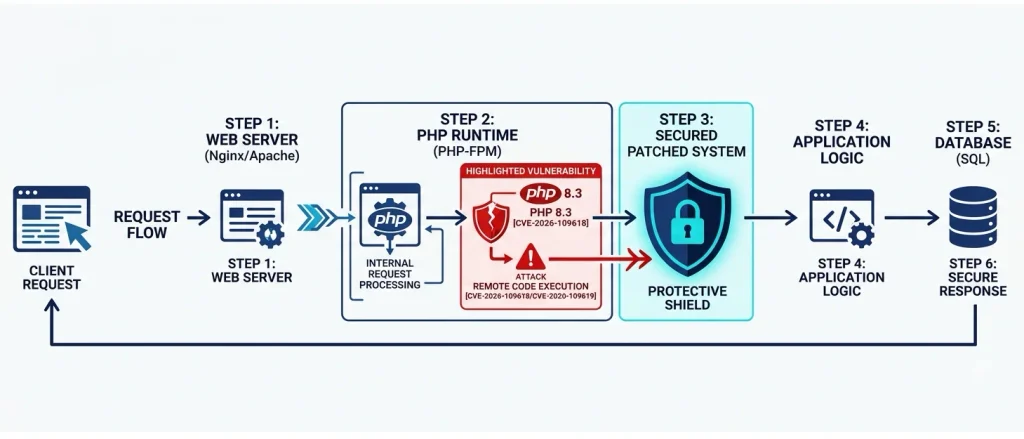
Both vulnerabilities affect PHP’s core runtime, the technology responsible for executing PHP code on a server. Google Cloud reported a Critical severity rating of 9.2 out of 10 for each vulnerability.
- CVE-2026-109618: A flaw in how PHP handles out-of-memory conditions may leave internal request data partially initialized, creating an opportunity for improper processing.
- CVE-2026-109619: Internal request state may remain in use after its backing memory has been freed, potentially allowing a later request to access invalid data.
If successfully exploited, these flaws could allow attackers to execute arbitrary code on affected systems. Depending on the environment and privileges, this may lead to server compromise, data theft, service disruption, or further malicious activity.
India’s CERT-In has also warned of the potential for remote code execution and reported large-scale exploitation in the wild. Organisations should therefore treat this as an urgent security issue rather than a routine software update.
Global Cybersecurity Response: What Countries and Agencies Are Doing
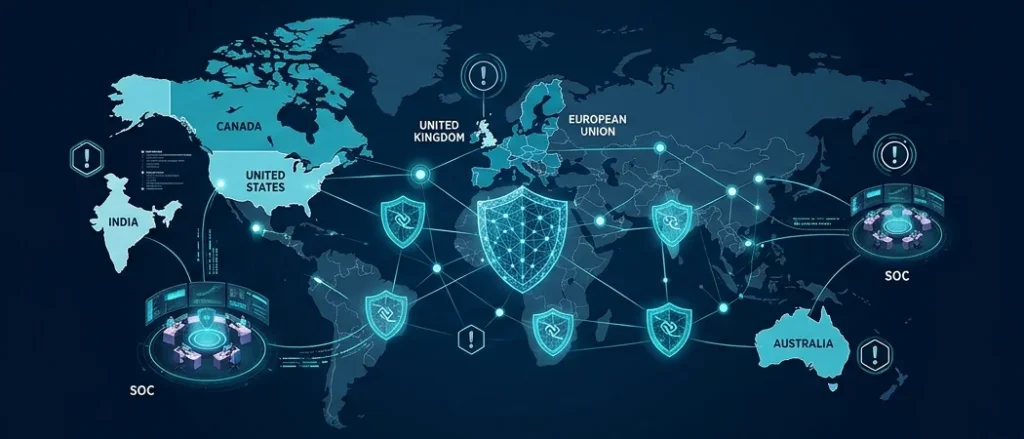
The response demonstrates how a vulnerability in one widely used technology can quickly become an international concern.
1. India: CERT-In Issues a Critical Alert
India’s Indian Computer Emergency Response Team (CERT-In) published vulnerability note CIVN-2026-0510 on October 21, classifying the issue as Critical.
The advisory urges organisations and individuals using PHP to apply the appropriate security updates. It identifies potential system compromise as a major risk and highlights reports of large-scale exploitation.
What businesses should do: Identify PHP-based systems, prioritise internet-facing applications, and apply the relevant security patches urgently.
2. United States: Security Authorities Urge Patching
The US National Security Agency (NSA) published a warning recommending critical security updates for the PHP vulnerabilities. The wider response reinforces the importance of securing web servers and software infrastructure against remotely exploitable flaws.
What businesses should do: Review server exposure, coordinate with hosting providers, and confirm that affected software has been updated.
3. United Kingdom: NCSC Highlights the Risk
The UK’s National Cyber Security Centre (NCSC) published a critical security alert explaining that the issue could allow attackers to execute commands on affected web servers.
What businesses should do: Review their PHP environments, follow official security guidance, and prioritise systems exposed to the public internet.
4. European Union: Agencies Call for Immediate Action
The European Union Agency for Cybersecurity (ENISA), CERT-EU, the European Commission, Europol, and the EU’s national cybersecurity incident-response network issued a joint statement urging organisations to address the vulnerabilities.
Their guidance recommends identifying PHP-based applications, coordinating with service providers, and isolating exposed applications from public networks when immediate patching is not feasible.
5. Canada and Australia: National Cybersecurity Advisories
Canada’s Canadian Centre for Cyber Security issued an advisory recommending that organisations identify affected systems and apply the available security updates immediately.
Australia’s Australian Cyber Security Centre also issued a critical alert, advising organisations to identify PHP deployments, monitor official guidance, prepare updates, and review applications for potentially malicious activity.
The global takeaway: Security agencies are aligned on the essential response—identify affected systems, apply fixes, and reduce exposure where remediation cannot happen immediately.
Which PHP Versions Are Affected?
Google Cloud’s advisory identifies PHP versions from 5.4 through 8.5.11 as affected. The following upstream PHP releases contain fixes:
| PHP branch | Patched release |
|---|---|
| PHP 8.5 | 8.5.12 |
| PHP 8.4 | 8.4.27 |
| PHP 8.3 | 8.3.36 |
| PHP 8.2 | 8.2.35 |
PHP 8.1 and earlier are end-of-life branches for which the PHP project is not releasing these fixes. Organisations using older versions should plan an upgrade to a supported PHP branch and verify compatibility with their applications.
Always check the official PHP security advisory and your operating system or hosting provider’s package guidance before making changes.
How Businesses Can Protect Their Websites

Organisations should take the following steps:
- Identify PHP usage: Check web servers, hosting accounts, containers, content management systems, and third-party applications.
- Apply security updates: Upgrade to a patched PHP release or an appropriate patched vendor package.
- Coordinate with hosting providers: Confirm whether runtime updates are automatic or require a manual rebuild and redeployment.
- Review logs and alerts: Look for unusual requests, unexpected processes, suspicious file changes, and other indicators of compromise.
- Back up critical data: Maintain verified backups and test recovery procedures.
- Investigate suspected compromise: Patching does not remove an attacker’s existing access. If a breach is suspected, follow incident-response procedures and seek qualified security support.
For WordPress sites, updating plugins and themes alone may not fix a vulnerability in the underlying PHP runtime. Website owners should confirm the PHP version with their hosting provider and check whether the server has received the required fix.
Why This Matters for Digital Business
Modern businesses depend on websites, customer portals, e-commerce systems, and other connected applications. A vulnerability in a shared technology layer can therefore create risks beyond a single application.
This incident reinforces the importance of secure software development, regular maintenance, application testing, and clear responsibility for updates. Businesses can explore XDT’s IT services and learn about cybersecurity developments at Singapore International Cyber Week 2026 to understand the wider connection between technology delivery and security.
For organisations building or modernising digital platforms, security should be considered throughout the development lifecycle—not only after a threat becomes public.
Conclusion
The PHP vulnerabilities CVE-2026-109618 and CVE-2026-109619 are a reminder that even widely adopted, established technologies require continuous security attention.
From India’s CERT-In to cybersecurity agencies in the US, UK, EU, Canada, and Australia, the message is consistent: identify affected systems, install the appropriate fixes, and investigate signs of compromise.
For businesses, acting promptly can help reduce exposure and protect the reliability of essential digital services. Regular updates, monitoring, and a proactive security strategy remain fundamental to maintaining trust in an increasingly connected world.
Need help planning or improving your digital technology? Explore XDT’s IT services or contact our team to discuss your business technology requirements.
Sources and Further Reading
- Google Cloud Blog: Responding to core PHP vulnerabilities CVE-2026-109618 and CVE-2026-109619
- India CERT-In: Vulnerability Note CIVN-2026-0510
- ENISA: Joint statement on critical PHP vulnerabilities
- UK NCSC: Critical security issue affecting PHP
- Canadian Centre for Cyber Security: PHP vulnerability alert
- Australian Cyber Security Centre: Critical vulnerabilities in PHP
- Official PHP security release announcement