
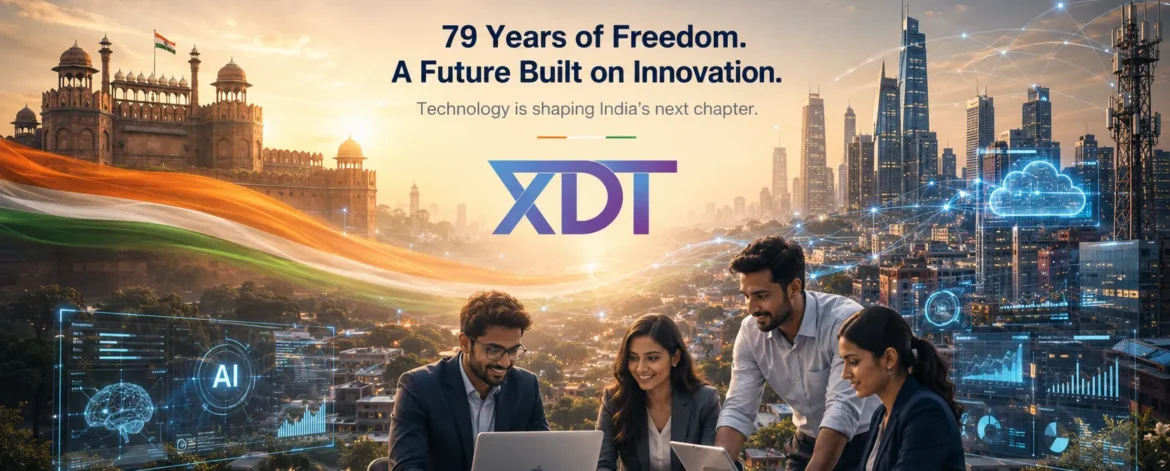
India’s independence was not simply the end of colonial rule. It was the beginning of a much larger responsibility: building a nation capable of determining its own future.
On 15 August 1947, India attained independence after a long freedom struggle, restoring political sovereignty to its people and beginning a new chapter of nation-building.
Today, as India completes 79 years of independence, the meaning of self-reliance has evolved.
Political freedom gave India the ability to shape its own destiny. Economic development strengthened that freedom. Education, infrastructure, industry and entrepreneurship expanded India’s capabilities.
Now, technology has become another important part of that journey.
From digital payments and online public services to cloud computing, artificial intelligence, software products and digitally enabled businesses, technology is changing how India works, competes and connects with the world.
The question for the next phase is no longer simply how India adopts technology.
It is how India can create, control, innovate and responsibly use technology to build a stronger and more self-reliant future.
From Political Independence to Digital Capability

The India of 1947 and the India of today operate in very different environments.
In the early years after independence, nation-building focused heavily on establishing institutions, infrastructure, industries and systems capable of supporting a young republic. The digital era has introduced another layer of capability.
Connectivity, software, digital identity, electronic payments, cloud infrastructure, data platforms and artificial intelligence have created new ways for citizens, businesses and institutions to operate.
The Government of India’s Digital India programme reflects this transformation through areas including broadband connectivity, mobile access, e-governance, electronic delivery of services, digital skills and electronics manufacturing.
This matters because digital capability is not simply about owning technology. It is about being able to use technology to solve problems at scale. A digitally capable business can automate repetitive processes, understand its customers more effectively, integrate systems and make decisions using better information.
A digitally capable public institution can deliver services more efficiently. A digitally capable citizen can access information, financial services and opportunities without being limited by physical boundaries.
That is where technology begins to contribute to self-reliance.
Digital India Is More Than Digital Services
The phrase “Digital India” is often associated with online services and digital infrastructure.
But the larger opportunity goes beyond digitizing existing processes. The real transformation happens when organizations rethink how work itself is performed. A paper-based process converted into a PDF is digitized.
A manual process redesigned around automation, data, integration and intelligent workflows is transformed. That distinction is important for Indian businesses.
As competition becomes increasingly global, businesses need more than websites and basic software systems. They need technology that can improve productivity, reduce operational friction, connect departments and help them respond faster to customers. This is where custom software, APIs, cloud platforms, mobile applications, business automation and modern digital infrastructure can become strategic assets.
Technology becomes valuable when it improves an actual business outcome.
The Rise of India’s Digital Economy

One of the clearest examples of India’s digital transformation is the growth of digital payments.
The Unified Payments Interface, or UPI, has become a significant part of India’s digital financial infrastructure. NPCI’s official statistics show that UPI processed more than 23.2 billion transactions in May 2026, with transaction value exceeding ₹29.9 lakh crore that month.
The importance of such systems extends beyond the numbers. Digital infrastructure can make transactions faster, reduce friction and create new possibilities for businesses of different sizes.
The broader lesson is significant:
When technology is designed around accessibility, interoperability and scale, it can transform everyday economic activity.
This is one of the reasons India’s digital journey is relevant to the idea of self-reliance.
Self-reliance does not mean operating in isolation. It means having the capabilities, infrastructure, knowledge and institutions required to participate confidently in the global economy.
Innovation Is Becoming a National Capability
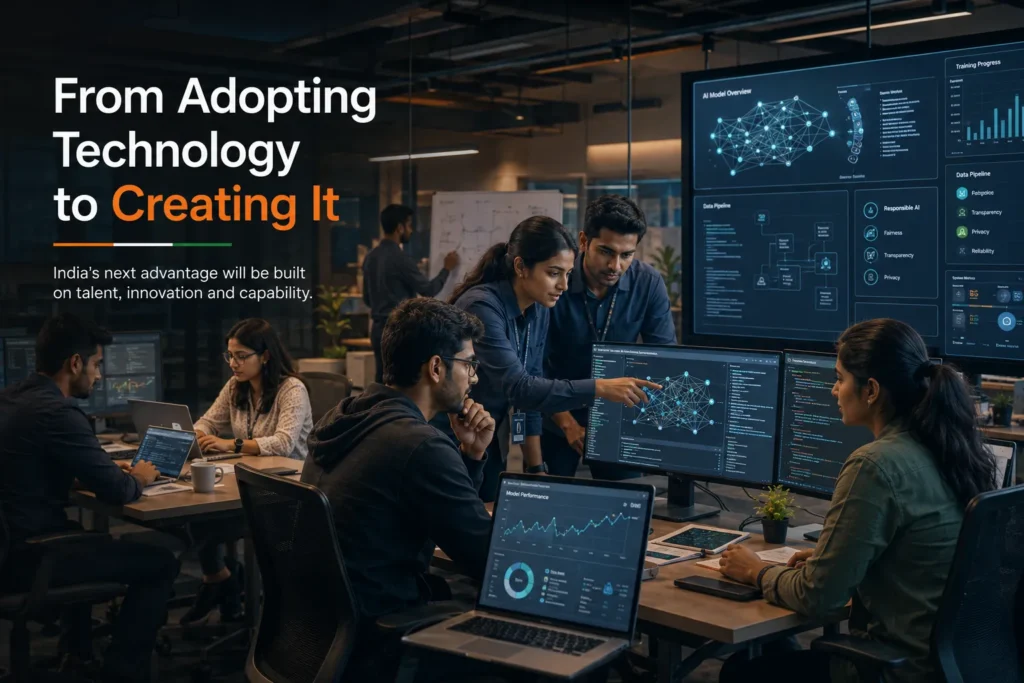
India’s technology story is also closely connected with entrepreneurship.
The Startup India initiative was launched in 2016 with the objective of strengthening India’s startup and innovation ecosystem. Its programs include support around funding, intellectual property, incubation, mentorship and entrepreneurship.
A strong startup ecosystem matters because innovation rarely comes from one source.
It comes from entrepreneurs identifying problems, researchers developing new ideas, engineers building solutions, investors providing capital and businesses adopting new technologies.
The result is an ecosystem in which ideas can move from concept to product and eventually to global markets. For India, this represents an important shift. The country is not only a market for technology.
It is increasingly a place where technology can be designed, developed, tested, scaled and exported.
Artificial Intelligence and the Next Stage of Self-Reliance
Artificial intelligence is likely to make the next stage of India’s technology journey even more significant.
AI has the potential to influence healthcare, manufacturing, agriculture, financial services, education, logistics, engineering, customer service and countless other areas.
But AI also introduces an important question:
How much control should a country have over the technologies that increasingly influence its economy and society?
India’s IndiaAI Mission reflects an effort to develop a broader AI ecosystem covering areas such as compute infrastructure, datasets, innovation, applications, future skills, startup financing and safe and trusted AI.
This approach highlights an important principle. Technological self-reliance does not necessarily mean building every technology independently. It means developing enough capability to understand critical technologies, contribute to their development, build solutions around them and make informed decisions about how they are deployed.
The Role of Indian Technology Companies
Large national initiatives can establish infrastructure and direction. But technology transformation ultimately happens through thousands of organizations building and implementing solutions every day.
This is where Indian technology companies have an important role. Their responsibility is not simply to write code.
It is to understand business problems.
- To design practical solutions.
- To modernize outdated systems.
- To help organizations automate repetitive work.
- To build reliable digital products.
- To integrate technologies.
- To maintain systems after deployment.
And increasingly, to help businesses determine where technology can create measurable value.
At Xchange Data Technologies (XDT), this philosophy connects closely with the company’s own evolution.
XDT began its journey in 2009 with engineering and Timber Truss Takeoff work before expanding into information technology and digital solutions. Today, its capabilities span software development, mobile and web applications, desktop applications, engineering design, digital transformation and offshore delivery.
That evolution reflects a broader Indian technology story:
Capability grows when experience, technology and people come together.
You can learn more about XDT’s journey and capabilities through its page.
What India’s Next Technology Chapter Could Look Like

The next phase of India’s development will likely be defined by the convergence of several technologies.
- Artificial intelligence can make systems more intelligent.
- Cloud platforms can make infrastructure more scalable.
- APIs can make systems more connected.
- Automation can reduce repetitive work.
- Data can make decision-making more informed.
- Cybersecurity can protect increasingly digital operations.
- Mobile technology can make services more accessible.
And skilled people can turn all of these technologies into meaningful solutions. The challenge will not simply be adopting these technologies. The challenge will be adopting them responsibly, strategically and inclusively.
Businesses will need to ask better questions:
- What problem are we trying to solve?
- Can technology make the process more efficient?
- Which capabilities should we build internally?
- Where should we collaborate with technology partners?
- How can we protect our data?
- How do we prepare our workforce for new technologies?
- How can we create technology that scales beyond today’s requirements?
These questions will shape India’s next generation of digital businesses.
India’s Independence Story Is Still Being Written

Independence gave India the freedom to determine its own path.
The decades that followed were about building institutions, infrastructure, industries and capabilities.
The digital era adds another responsibility: building technological capabilities that allow India to compete, innovate and create value in an increasingly connected world.
At 79 years of independence, India’s story is not about reaching an endpoint. And building an economy capable of creating solutions not only for India, but for the world.
Technology will not accomplish that alone. People, institutions, entrepreneurs, businesses, researchers and policymakers will all have a role to play.
But technology can become one of the strongest tools available to the next generation of India.
As we celebrate Independence Day on 15 August 2026, perhaps the most meaningful way to look toward the future is not simply to ask how far India has come.
It is to ask:
What capabilities will we build next?
Because the next chapter of India’s independence will not only be measured by what India can do for itself.
It will also be measured by what India can create for the world.
A Note from XDT
At Xchange Data Technologies, we believe technology is most valuable when it solves real business problems and creates opportunities for people and organizations to grow.
From software development and digital transformation to engineering solutions and offshore technology delivery, our journey since 2009 has been shaped by the same principle: understand the need, build the right solution and deliver it with responsibility.
This Independence Day, we celebrate India’s journey—and look forward to being part of the technology journey that lies ahead.
Happy Independence Day 2026.
Jai Hind.